
Microbial Studies
微生物寫生
Microscope, drawing, painting, video, installation, found objects
Dimensions variable
2025
Exhibition:2024 Asian Art Biennial How to Hold Your Breath
National Taiwan Museum of Fine Arts (NTMoFA), Taichung, Taiwan


During the COVID-19 pandemic, I began growing plants. Wanting to better understand how they lived and developed, I became interested in the microorganisms inhabiting the soil. This curiosity led me to ask a simple question: what do these invisible forms of life actually look like? Using a microscope, I began observing soil microorganisms and recording them through drawing.
Microbial Studies is not intended as a scientific investigation, but rather as an exploration of drawing from observation as a way of understanding the world. Traditionally, sketching is directed toward landscapes, architecture, plants, or the human figure. In this work, however, the subject shifts toward a realm that is equally real but inaccessible to the naked eye. The microscope changes not only the scale of perception, but also the very subject of observation, allowing an otherwise invisible world to become the starting point of artistic practice.
As I observed these microscopic forms, I found myself reconsidering the meaning of abstraction. To me, the organisms seen through the microscope are not abstract at all—they are tangible forms of life that exist and can be directly observed. Yet for viewers unfamiliar with this microscopic world, the resulting images often resemble abstract paintings. The work therefore raises a question: is abstraction truly detached from reality, or is it simply reality that has not yet been recognized? The boundary between abstraction and representation does not lie within the image itself, but within the viewer's experience and knowledge.
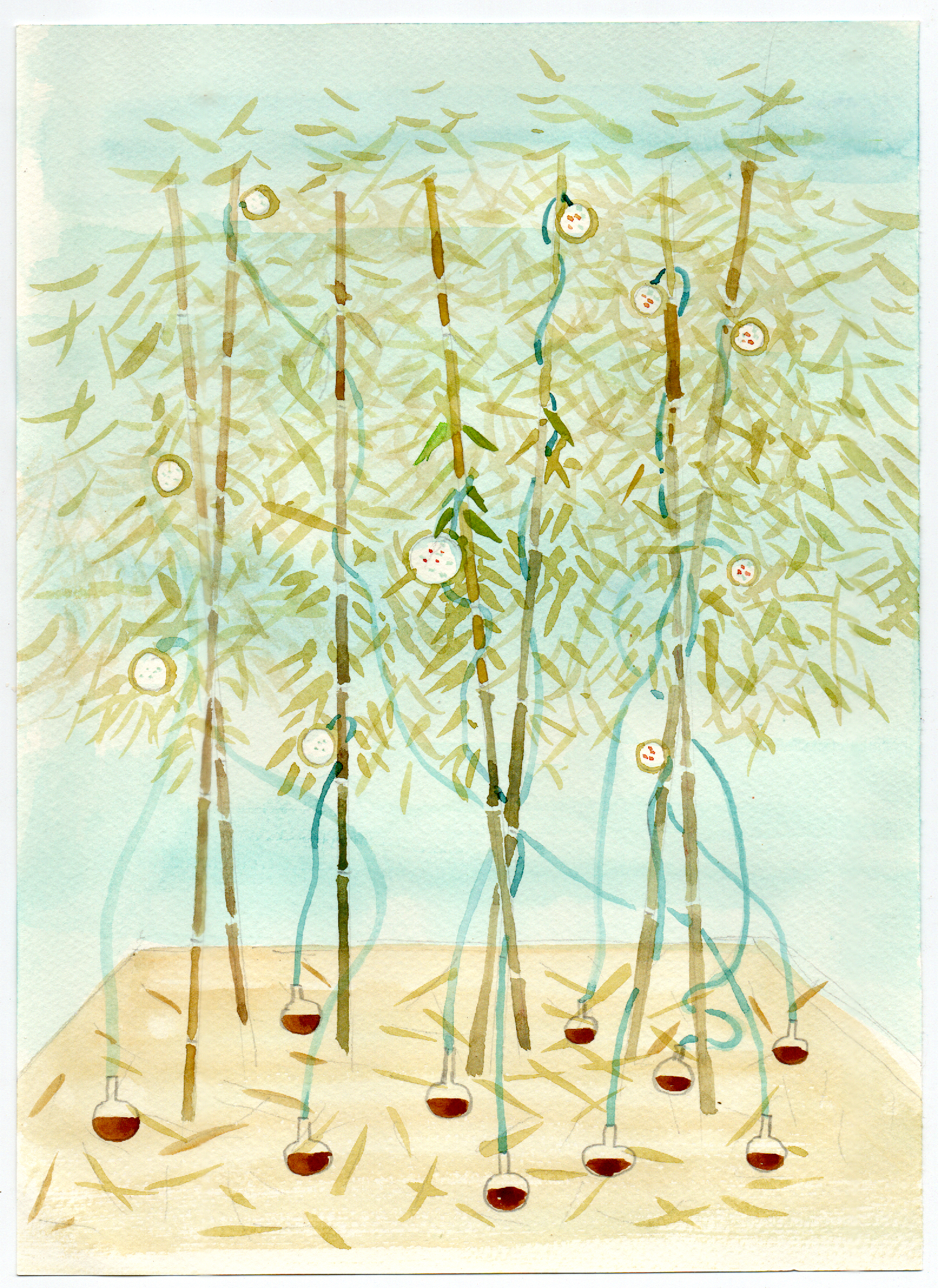
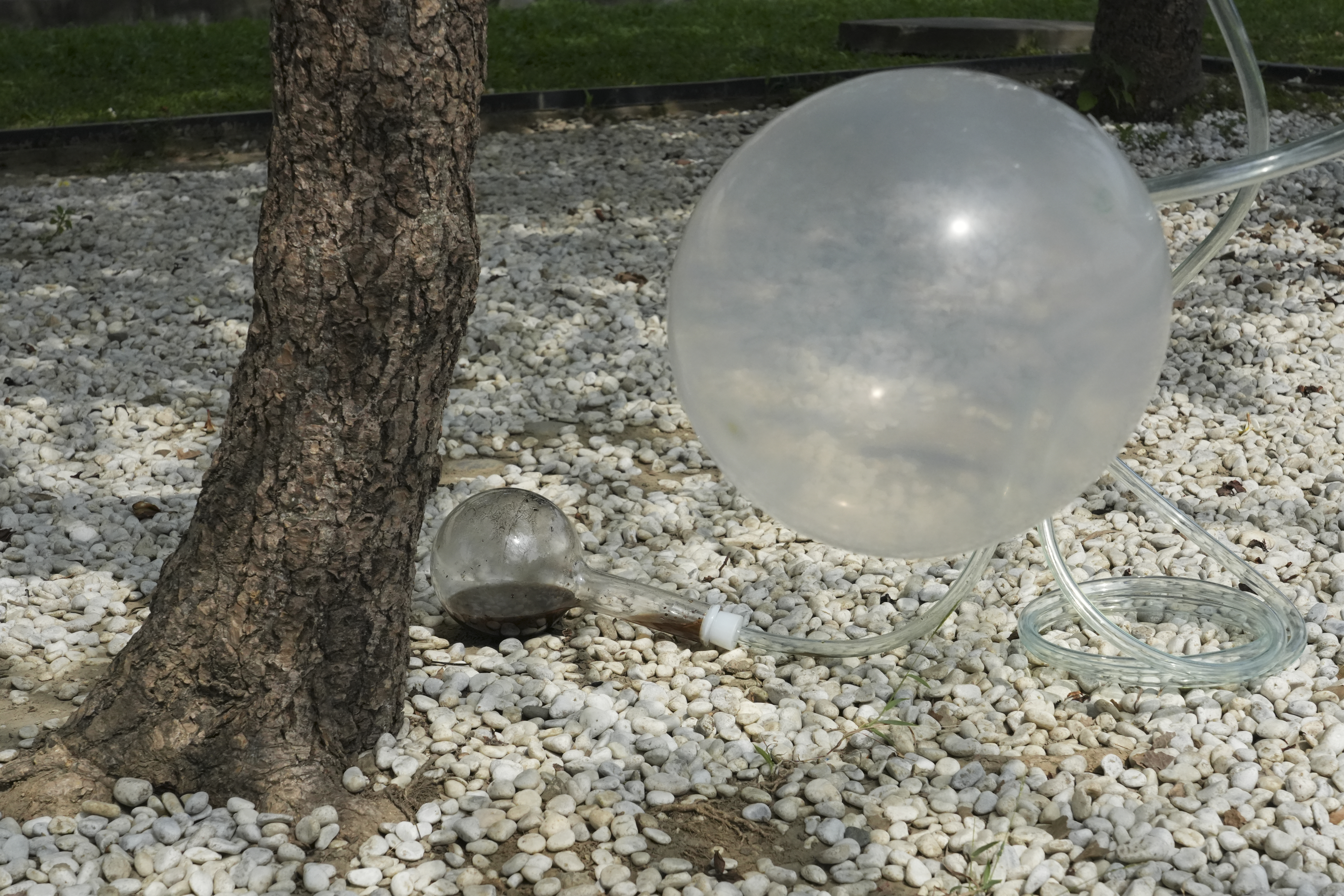
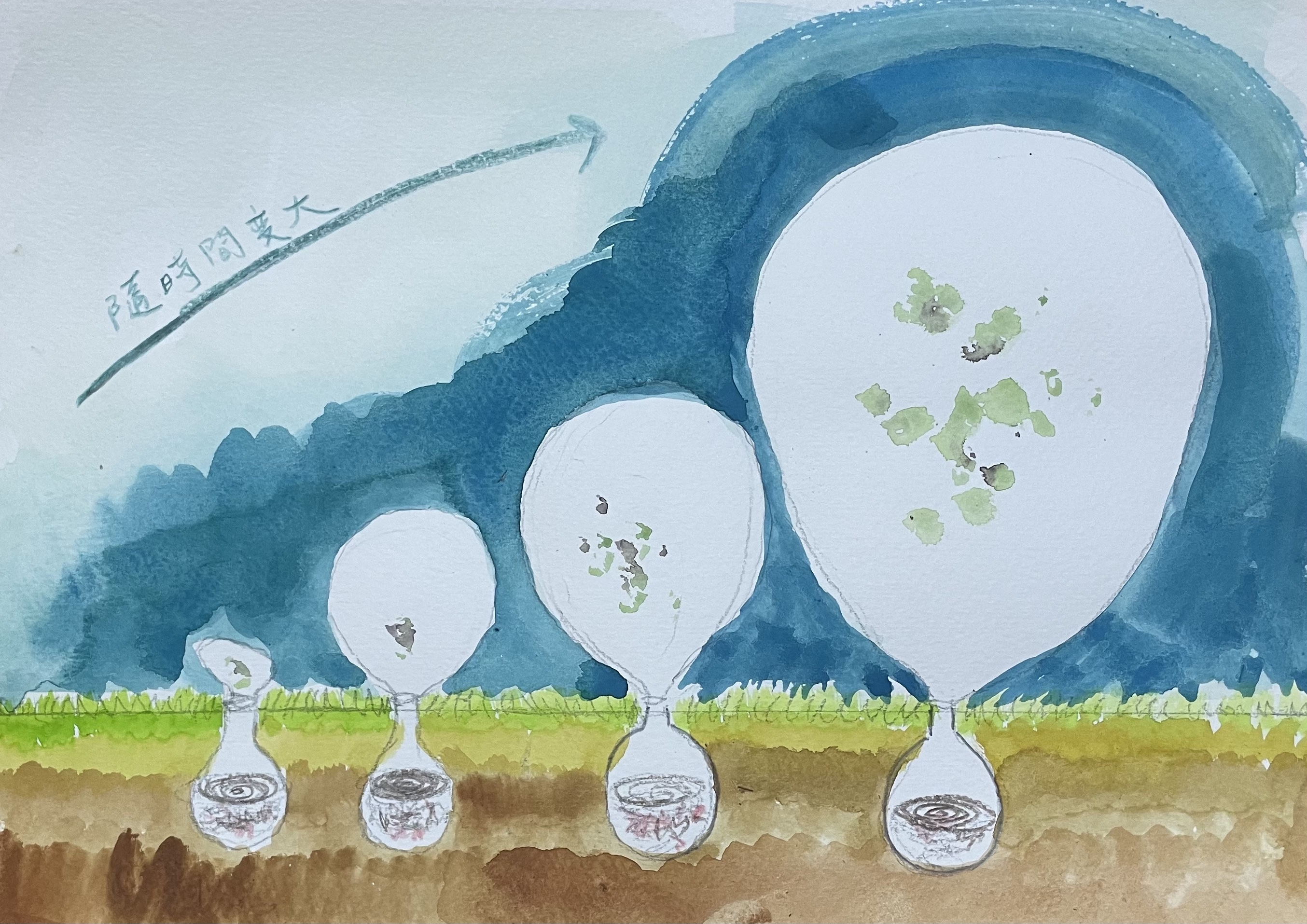
Alongside the paintings, the project includes a living installation. Soil containing microorganisms is cultivated inside a laboratory flask using enzyme-assisted fermentation. The flask is connected by a glass tube to a balloon, which gradually inflates as gases produced by microbial activity accumulate over time. Rather than presenting the microorganisms themselves, the installation reveals traces of their existence. Through an ongoing process of fermentation, an otherwise invisible biological activity is transformed into a physical phenomenon that can be directly perceived.
Throughout the project, I also became interested in the microscope itself as a medium of perception. We often assume that vision through our own eyes is immediate and objective, yet human sight is already mediated through the lens of the eye. In this sense, the microscope does not create another world; it simply introduces another layer of vision, extending our perception toward a different scale of reality. This idea of looking through layers of transparent lenses is reflected in the paintings themselves. Transparent washes, overlapping forms, and permeable layers evoke the experience of seeing through multiple optical surfaces. Transparency is therefore not merely a visual language, but a metaphor for perception itself—a reminder that every act of seeing is mediated.
Ultimately, Microbial Studies is not a work about microorganisms. It is a work about perception. As the tools through which we observe the world change, so too does the world that becomes visible to us. Drawing from observation is therefore not simply a means of depicting what we see, but a continual process of expanding the ways in which we come to understand reality.


疫情期間,我開始種植植物。為了理解植物的生長,我開始研究土壤中的微生物,也因此對那些肉眼無法察覺卻真實存在的生命產生了好奇。我想知道,它們究竟長什麼樣子?於是,我開始透過顯微鏡觀察土壤中的微生物,並以寫生的方式記錄它們。
《微生物寫生》並非以科學研究或生物學為目的,而是將「寫生」視為一種理解世界的方法。過去的寫生多半面向山川、植物、建築或人物,而這一次,我試圖描繪的是另一個同樣真實卻無法以肉眼直接觀看的世界。顯微鏡改變了觀看的尺度,也改變了寫生的對象,使原本隱藏於日常經驗之外的生命,成為創作的起點。
在觀察的過程中,我逐漸開始思考「抽象」究竟是什麼。對我而言,顯微鏡下所見的形態並不是抽象的,它們是真實存在且可以被直接觀察的生命。然而,對未曾看過這些景象的人而言,畫面中的線條、色彩與形態卻往往被理解為抽象繪畫。於是,作品也提出一個問題:抽象是否真的是脫離現實的形式?或者,它只是我們尚未辨認、尚未理解的真實?抽象與寫實的界線,並非存在於圖像本身,而是存在於觀看者的經驗之中。
除了繪畫之外,作品亦包含一件持續運作的裝置。我將培養中的土壤置於燒瓶中,透過酵素培養土壤中的微生物,再以玻璃管連接一顆氣球。隨著微生物持續代謝與發酵,所產生的氣體逐漸使氣球膨脹,讓那些肉眼無法直接看見的生命活動,轉化成可以被感知的物理現象。作品並非展示微生物本身,而是展示它們存在的痕跡,使不可見的生命,透過時間的累積,在展覽空間中逐漸被看見。
在創作的過程中,我也開始思考顯微鏡本身作為一種觀看媒介的意義。我們總以為肉眼所見是真實的,但人的眼睛本身也是一組透鏡。從這個角度來看,顯微鏡並不是創造另一個世界,而只是增加了一層觀看的媒介,使我們得以進入不同尺度的真實。因此,我將這種「隔著透鏡觀看」的經驗轉化為畫面中的透明層次。色彩彼此滲透、形體相互重疊,如同視線穿越一層又一層透明介面。透明不只是繪畫的形式語言,更象徵觀看本身始終受到媒介的影響。
《微生物寫生》最終所探討的,並不是微生物,而是觀看。當觀看的工具改變,世界便隨之改變;而我們所理解的真實,也始終建立在觀看的方法與尺度之上。寫生因此不只是描繪眼前所見,而是一種不斷重新認識世界的過程。
